

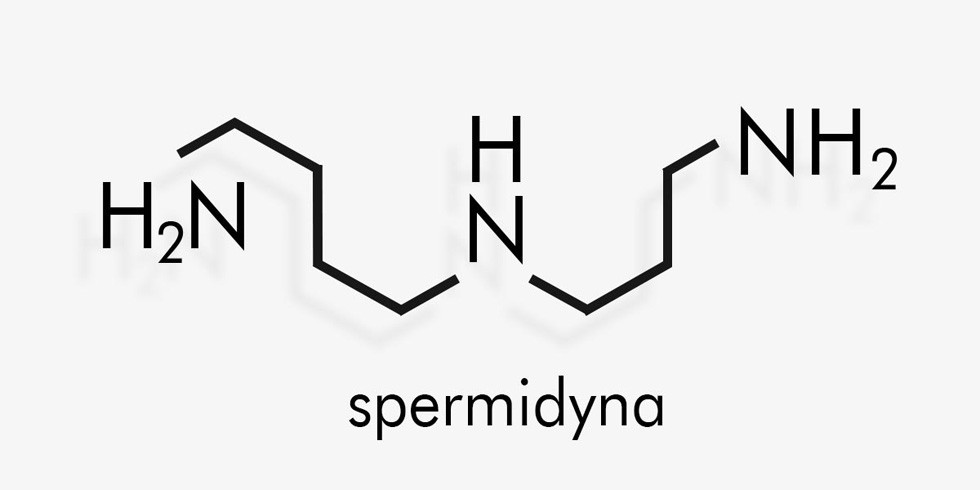


Current research focuses on spermidine's lifespan-extending effects on the human body, including improvements in skin appearance and quality and enhanced mitochondrial function in cellular respiration. What is spermidine, and what are its properties?
What is spermidine?
Spermidine is a chemical compound belonging to the group of polyamines. It is naturally found in the cellular environment, within mitochondria, vacuoles, the cell nucleus, and the nucleolus. Spermidine has three amino groups, which are responsible for shaping its health-promoting properties.
Spermidine is naturally found in human semen, as the transparent substance of the ejaculate. It is also found in foods such as wheat germ, cruciferous vegetables, amaranth, mushrooms, soybeans, whole grains, and some legumes.
Properties and effects of spermidine
Spermidine is related to other polyamines, such as putrescine and spermine. Spermidine's main property is to promote longevity and limit the effects of ageing. This effect primarily involves protecting cellular DNA and sperm DNA. As a result, this component reduces free radical activity, thereby benefiting the body and promoting long-term health.
However, spermidine's most important role is its influence on mitochondrial autophagy.
Spermidine and Mitochondrial Autophagy
Mitochondria are small cellular organelles whose primary function is to produce the energy molecule ATP (adenosine triphosphate) for the human body. The presence of this compound is essential for the proper functioning of the entire body. Given the importance of mitochondria, numerous preparations have been developed to support their health and promote their recycling. Mitochondrial recycling is an essential element of metabolism, contributing to the removal of defective mitochondria damaged by free radical activity and inflammation.
Damaged mitochondria are unable to produce energy effectively, and therefore, in the presence of compounds such as spermidine, they are deactivated and subject to the recycling described above. By replacing defective mitochondria with new, efficiently functioning ones, the body's energy production process can be restored.
Spermidine has an anti-ageing effect
Another essential property of spermidine is its rejuvenating effect. This is due to its ability to reduce pro-inflammatory cytokines. Inflammation damages not only DNA but also collagen structures and other elements, affecting the proper functioning of internal organs and beyond. Spermidine supplementation helps reduce pro-inflammatory cytokines and promotes the regeneration of damaged structures. It's worth noting that the body's ability to produce spermidine declines over time, which increases the risk of lifestyle diseases in older adults.
Spermidine and its properties supporting cognitive function
A key element in maintaining good health is the regeneration of the nervous system. Its activity is linked to cognitive functions, which are supported by spermidine supplementation, including those from wheat germ extract. This compound limits the destructive activity of pro-inflammatory cytokines, improves cerebral microcirculation, and enables the formation of new neural connections and the development of new nerve cells.
Spermidine and viral infections
Another beneficial effect of spermidine is its ability to alleviate viral infections. Viral activity is associated with inhibition of mitochondrial autophagy and subsequent oxidative stress-induced damage. Administering spermidine to such individuals significantly alleviates symptoms of infection and accelerates recovery.
Spermidine regulates hormonal balance in both women and men
Another property of spermidine is its support for hormonal regulation. Spermidine, in the form of wheat germ extract, helps reduce excessive cortisol, a hormone that, when present in excess, causes hormonal imbalances. This allows for the restoration of proper levels of steroid hormones, such as testosterone in men, estradiol in women, and progesterone in both sexes. This property also increases libido and benefits fertility.
Given spermidine's beneficial effect on mitochondrial function, it's worth considering other systems that contain large amounts of mitochondria. This means that spermidine supplementation may positively impact the function of the:
- kidneys,
- liver,
- skin,
- intestines,
- adrenal glands,
- heart,
- lungs,
- and the musculoskeletal system.
Spermidine dosage and when it works best?
To maximise health benefits, adhere to the recommended spermidine dosage. This is 1 mg per day, typically found in 100 mg of wheat germ extract.
Spermidine should be combined with other active ingredients that have a beneficial effect on mitochondrial metabolism. Among the substances that positively impact mitochondrial health and work synergistically with spermidine are:
- Coenzyme Q10,
- magnesium,
- N-acetyl-L-carnitine,
- and PQQ (pyrroloquinoline quinone).
These substances are found in the BestLife supplement. This product is designed for preventive care and helps minimise inflammation. BestLife is a dietary supplement that prevents DNA damage, acts as a prophylactic against metabolic problems, and boosts energy. The presence of these other substances positively impacts well-being and physical performance.
Importantly, spermidine has not shown any side effects in studies.
Spermidine – summary
Spermidine is a naturally occurring compound found in foods and in human semen. It turns out that this substance has numerous health benefits, primarily by improving mitochondrial function and eliminating defective mitochondria. Furthermore, spermidine has strong antioxidant properties, which is crucial when combating excessive proinflammatory cytokines.
Spermidine has no apparent side effects. The daily dose of spermidine should be around 1 mg. This is the dose included in our comprehensive BestLife formula, designed for individuals who wish to support their mitochondrial health.

Sources
- Madeo F, Bauer MA, Carmona-Gutierrez D, Kroemer G. Spermidine: a physiological autophagy inducer acting as an anti-aging vitamin in humans? Autophagy. 2019 Jan;15(1):165-168.
- Madeo F, Carmona-Gutierrez D, Kepp O, Kroemer G. Spermidine delays aging in humans. Aging (Albany NY). 2018 Aug 6;10(8):2209-2211.
- Francesca Mocci,Aatto Laaksonen,Leon Engelbrecht,Tudor Vasiliu,Sergiy Perepelytsya,DNA-Polyamine Interactions: Insight from Molecular Dynamics Simulations on the Sequence-Specific Binding of Spermidine3+, Soft Matter Systems for Biomedical Applications, (163-192).
- Wirth, M., Schwarz, C., Benson, G. et al. Effects of spermidine supplementation on cognition and biomarkers in older adults with subjective cognitive decline (SmartAge)—study protocol for a randomized controlled trial. Alz Res Therapy 11, 36 (2019).
- Stefan Kiechl, Raimund Pechlaner, Peter Willeit, Marlene Notdurfter, Bernhard Paulweber, Karin Willeit, Philipp Werner, Christoph Ruckenstuhl, Bernhard Iglseder, Siegfried Weger, Barbara Mairhofer, Markus Gartner, Ludmilla Kedenko, Monika Chmelikova, Slaven Stekovic, Hermann Stuppner, Friedrich Oberhollenzer, Guido Kroemer, Manuel Mayr, Tobias Eisenberg, Herbert Tilg, Frank Madeo, Johann Willeit, Higher spermidine intake is linked to lower mortality: a prospective population-based study, The American Journal of Clinical Nutrition, Volume 108, Issue 2, August 2018, Pages 371–380.
- Karacay, C., Prietl, B., Harer, C. et al. The effect of spermidine on autoimmunity and beta cell function in NOD mice. Sci Rep 12, 4502 (2022).
Check our offer